




Memorandum of Agreement 2020
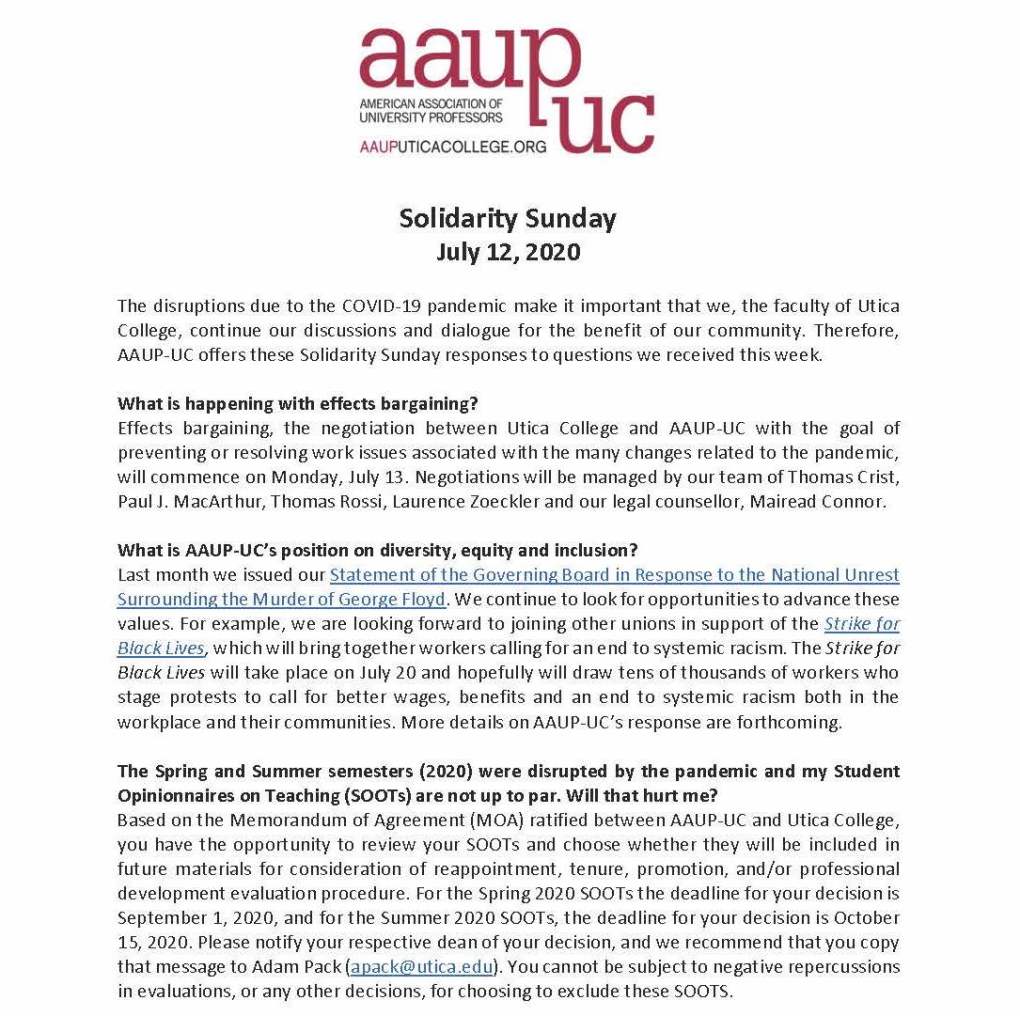
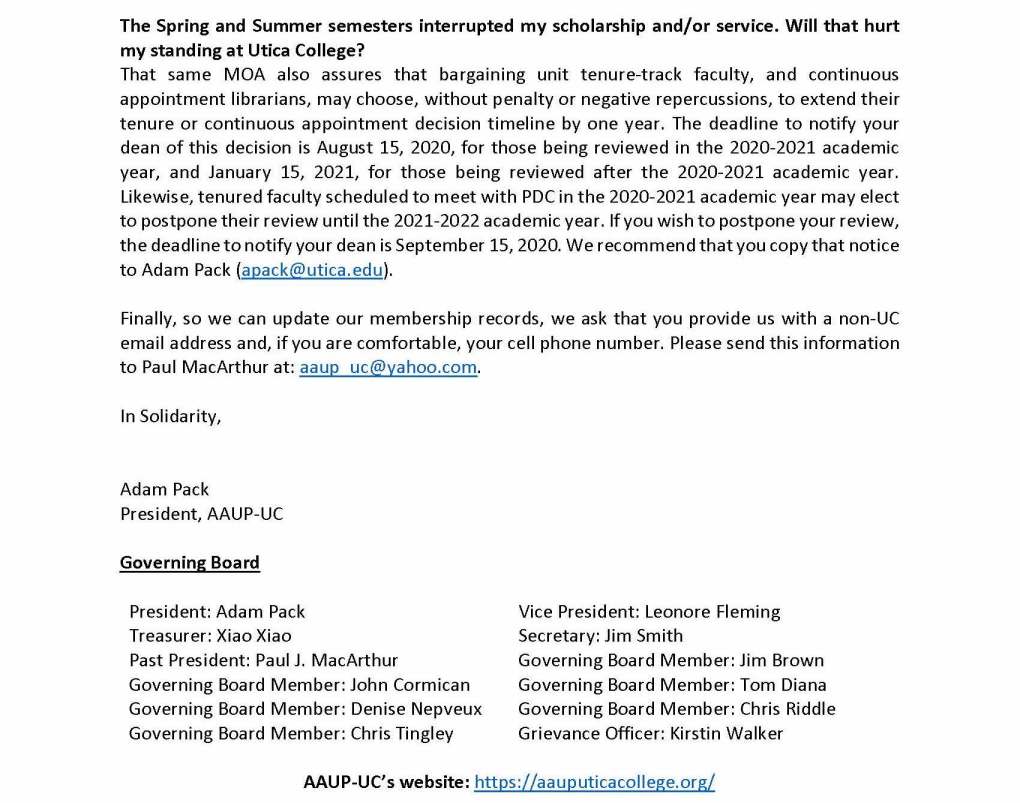
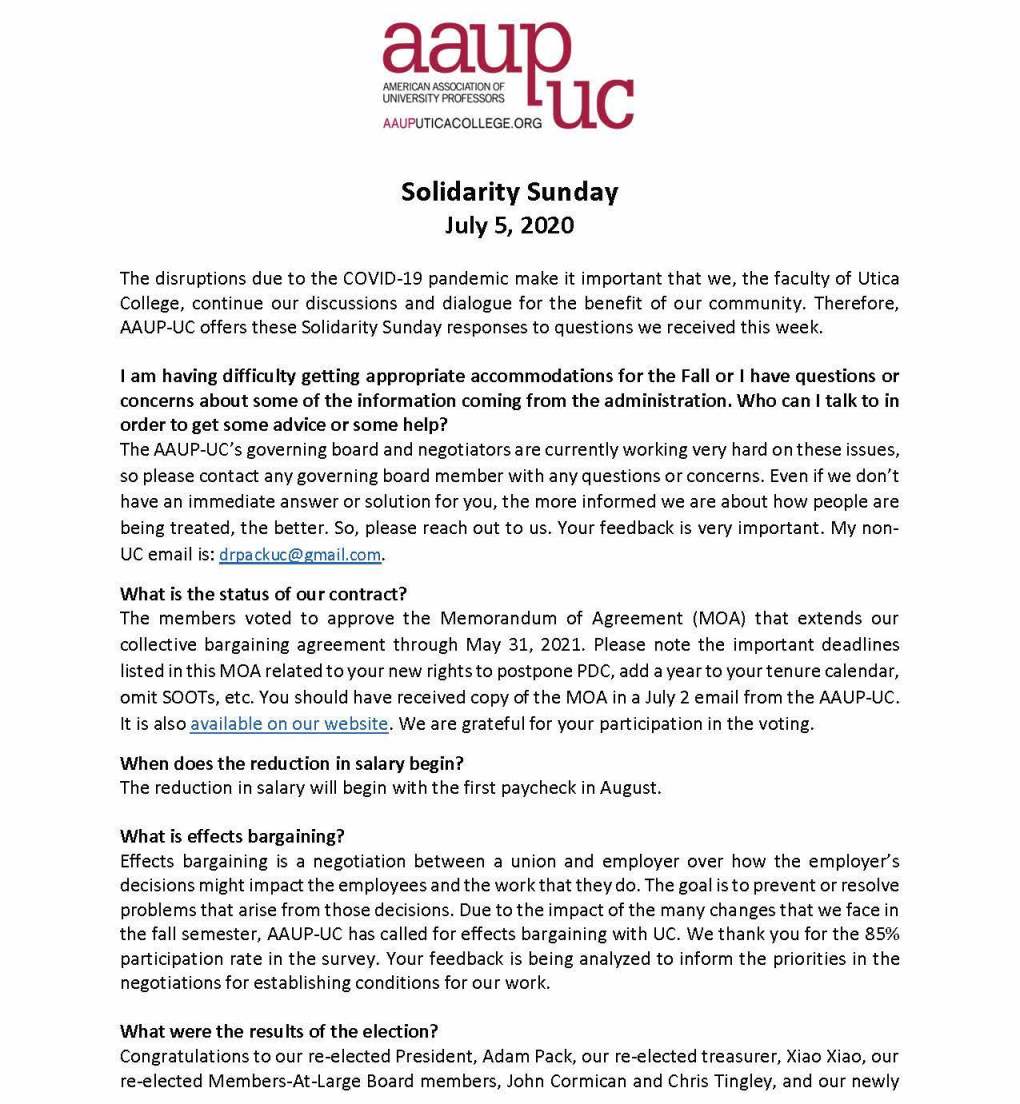
On July 2, 2020, a memorandum of agreement (MOA) that extends the Collective Bargaining Agreement between the AAUP-UC and Utica College through May 31, 2021, was ratified by the AAUP-UC membership.
Reminder, if you are planning to exercise your new rights to postpone PDC, add a year to your tenure calendar, omit SOOTs, etc., please take note of the important deadlines listed in the MOA.
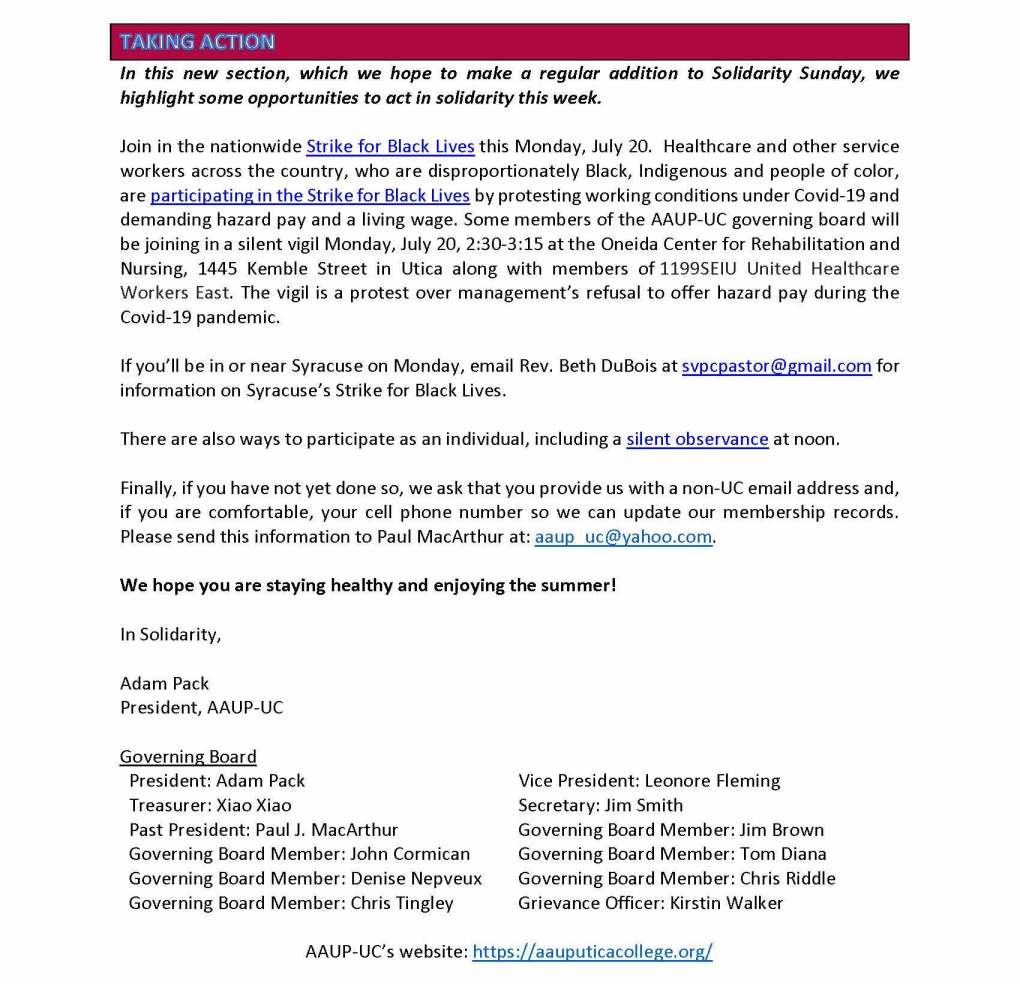
Congratulations to our new board members!
Congratulations to our re-elected President, Adam Pack, our re-elected treasurer, Xiao Xiao, our re-elected at-large board members, John Cormican and Chris Tingley, and our newly elected at-large board member, Denise Nepveux, who will take office on July 1.
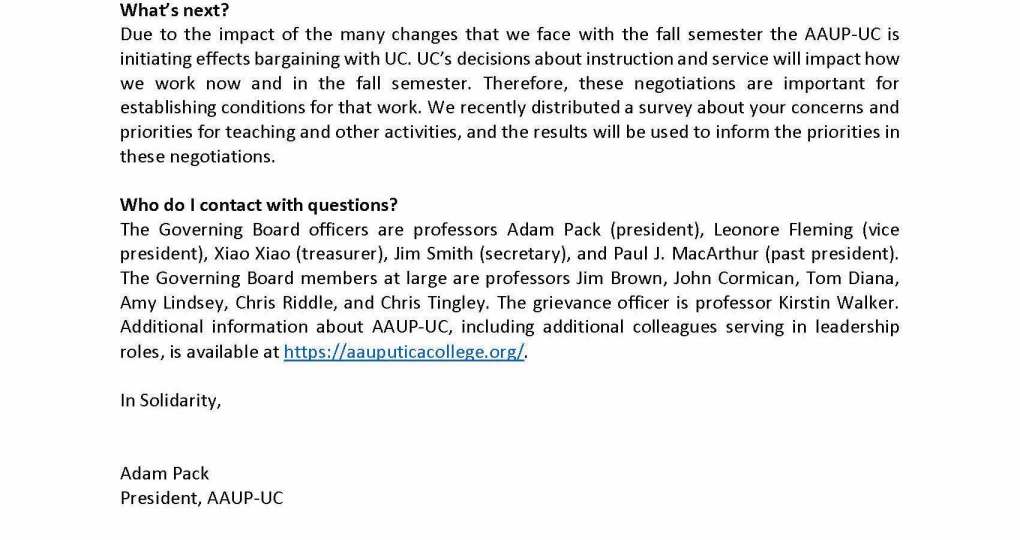
The AAUP-UC Governing Board for 2020-2021 is:
Governing Board Officers:
- President: Adam Pack, Professor of Biology
- Vice President: Leonore Fleming, Associate Professor of Philosophy
- Treasurer: Xiao Xiao, Professor of Mathematics
- Secretary: Jim Smith, Professor of Physical Therapy
- Past President: Paul J. MacArthur, Professor of Public Relations and Journalism
Governing Board Members At Large:
- Jim Brown, Associate Professor of Criminal Justice
- John Cormican, Professor of English
- Tom Diana, Associate Professor of Education
- Denise Nepveux, Associate Professor of Occupational Therapy
- Chris Riddle, Associate Professor of Philosophy
- Chris Tingley, Assistant Professor of Marketing and Strategy.
We also want to take a moment to thank Amy Lindsey, whose term ended on June 30, for her service on the Governing Board. We really appreciate her dedication to the union and her efforts to make our union stronger.
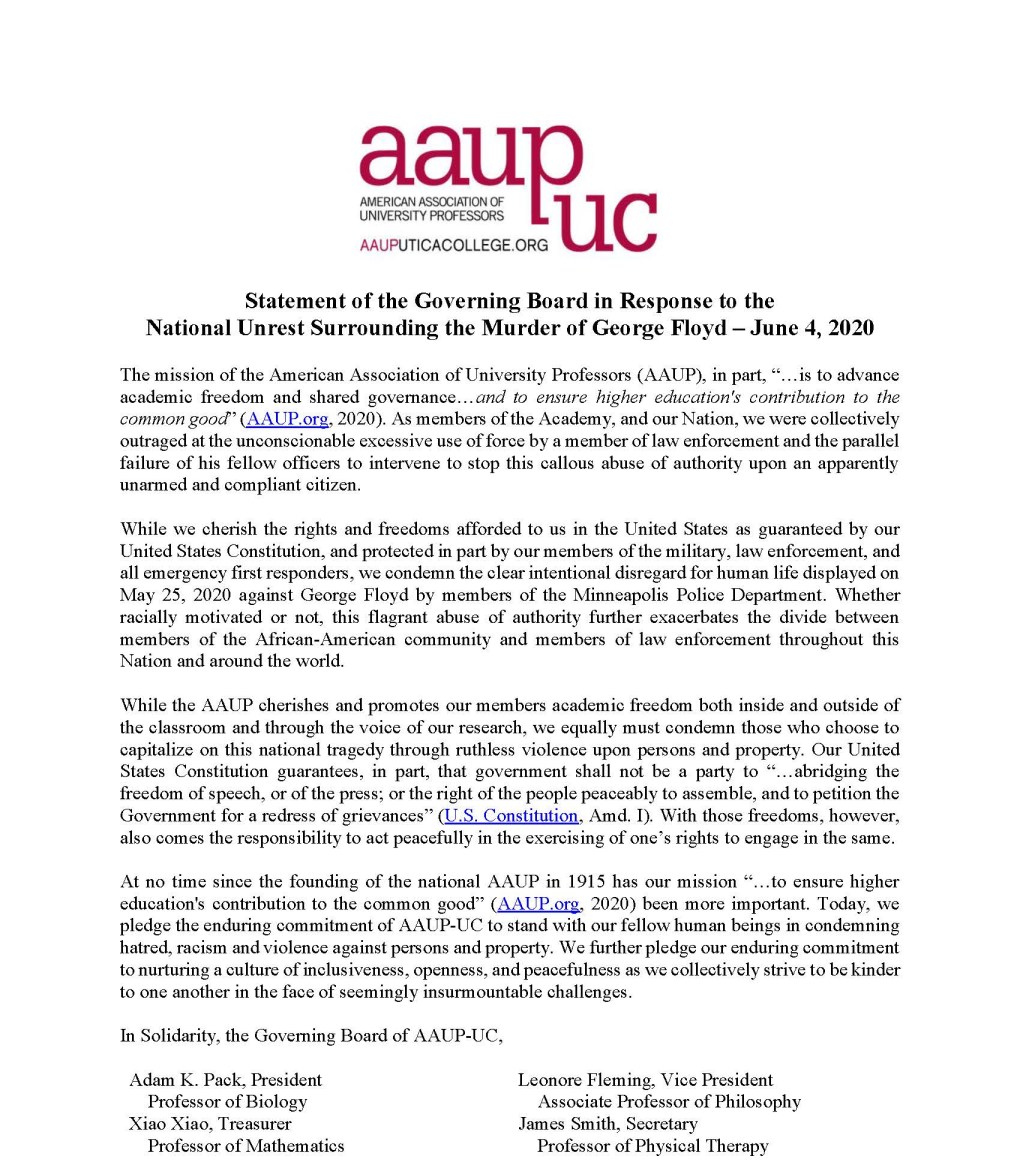
Statement of the Governing Board in Response to the National Unrest Surrounding the Murder of George Floyd
The AAUP-UC Governing Board issued the following statement earlier today:

AAUP president Rudy Fichtenbaum issued a Statement on Protests in Response to the Murder of George Floyd on June 1st.
Congratulations to the 2020 AAUP-UC Scholarship Winners!
From a number of very qualified submissions, the Scholarship Selection Committee is proud to announce the following 2020 AAUP-UC Scholarship Winners, which were announced at the AAUP-UC General Membership Meeting on May 14, 2020:
The Virgil C. Crisafulli Scholarship for leadership and service in the spirit of the AAUP was awarded to Anastasia Shikula, nominated by Sara Scanga, Professor of Biology and Benjamin Williamson, Assistant Professor of Chemistry.
The Robert W. Millett Scholarship for Academic Achievement was awarded to Kierra Caissey, nominated by John Schwoebel, Associate Professor of Psychology.
Congrats to our winners!
Read more about the AAUP-UC Scholarships and see past winners here.
 AAUP Utica